
Owning a rental property can be a rewarding investment, but dealing with unpaid rent, lease violations, or a tenant who refuses to move out can create significant challenges for property owners.Understanding the Illinois eviction process for landlords is important because an eviction is not simply a matter of asking a tenant to leave. In Illinois, eviction is a legal court process, and landlords must follow the required notice, filing, service, hearing, and enforcement procedures. For property owners, the biggest lesson is simple: a mistake early in the process can delay the entire case.
This guide explains the major steps involved in the Illinois eviction process for landlords in 2026 and highlights practical considerations owners should understand before taking action.
Important: This article is for general educational purposes and is not legal advice. Eviction requirements can depend on the property location, lease, reason for eviction, and applicable state or local laws. Owners should consult a qualified Illinois attorney when legal advice is needed.
Table of Contents
What Is the Illinois Eviction Process?

The Illinois eviction process for landlords is a legal procedure used to obtain possession of a rental property when a tenant does not voluntarily leave after the landlord has a lawful basis to terminate the tenancy. An eviction is not completed simply because a landlord sends a letter or serves a notice.
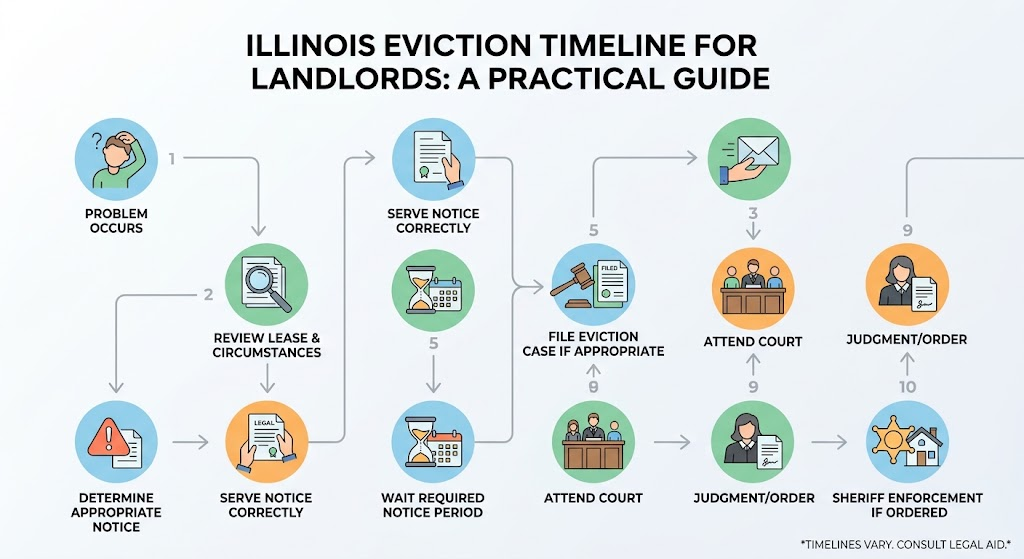
In Illinois, the process generally involves:
- Identifying the legal reason for seeking possession.
- Serving the required written notice, when applicable.
- Waiting for the required notice period to expire.
- Filing an eviction case with the appropriate circuit court.
- Serving the tenant with the court papers.
- Attending the required court proceedings.
- Obtaining an eviction order if the court rules in the landlord’s favor.
- Scheduling enforcement with the sheriff.
Illinois Legal Aid Online explains that only the sheriff can physically carry out an eviction after a judge has entered an appropriate order. A landlord cannot personally remove a tenant, even after obtaining a judgment.
Step 1: Identify the Reason for the Eviction
Before beginning the Illinois eviction process for landlords, determine exactly why possession is being sought.
Common situations include:
- Unpaid rent
- Material lease violations
- Certain other defaults under the lease
- A tenancy that has ended
- A tenant remaining after the lawful termination of the tenancy
- Certain situations involving unauthorized occupants
The reason matters because it can determine what notice is required, how much time must be provided, whether the tenant can correct the problem, and what the landlord may need to prove in court. Illinois Legal Aid Online notes that the reason for the eviction affects whether a written notice is required, whether the tenant can correct the issue, how long the landlord must wait before filing, and what must be proven in court.
Example: Unpaid Rent
For nonpayment of rent, Illinois law generally provides for a written demand giving the tenant at least five days after service to pay the amount demanded before the lease may be terminated under the applicable statute.
Example: Lease Default
For certain defaults in the terms of a lease, Illinois law provides for a 10-day notice to quit or terminate the tenancy.
Example: Certain Tenancy Terminations
Illinois law also provides different notice periods for certain periodic tenancies. For example, Section 9-207 provides for seven days for week-to-week tenancies and 30 days for certain tenancies of less than one year when the tenant holds over without a special agreement.
The important point for owners: do not assume that every eviction begins with the same notice.
The correct notice depends on the circumstances.
Step 2: Review the Lease and Local Requirements
Before serving an eviction notice, carefully review the lease.
Check:
- Tenant and owner names
- Property address
- Lease term
- Rent amount
- Payment history
- Relevant lease provisions
- Late-payment provisions
- Rules and regulations
- Default provisions
- Notice requirements
- Renewal or termination provisions
Owners should also determine whether local rules apply to the property. Illinois landlords may be subject to requirements beyond statewide statutes depending on the property’s location. Chicago and other municipalities may have additional landlord-tenant requirements. This is especially important for owners with properties in different municipalities because a procedure that applies to one property may not necessarily apply to another.
Step 3: Serve the Correct Eviction Notice
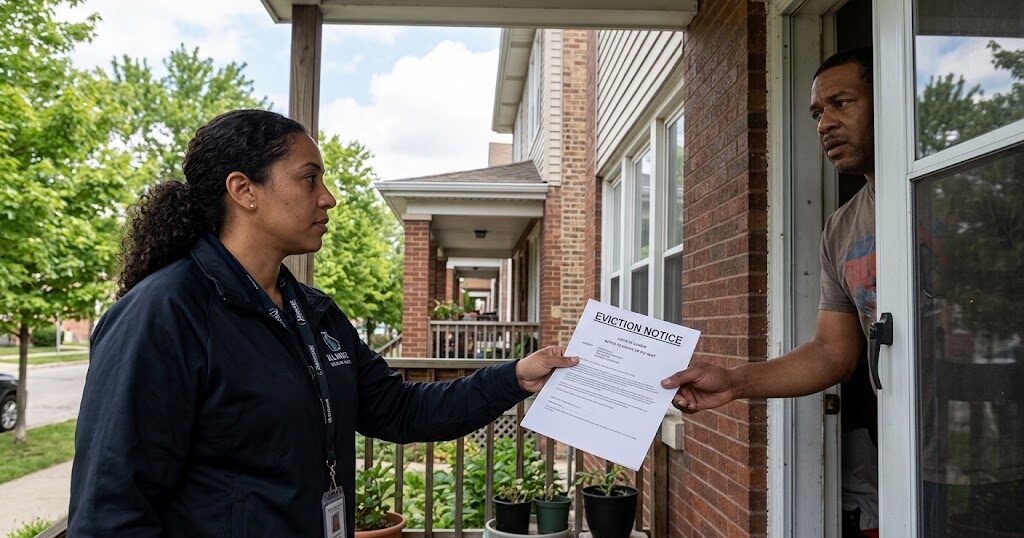
Serving the correct notice is one of the most important stages of the Illinois eviction process for landlords. A written eviction notice is not itself a court order. It is a legal notice communicating the landlord’s position and, depending on the situation, providing the tenant an opportunity to pay, cure a violation, or vacate. The notice should accurately identify the relevant information and comply with the applicable service requirements. Illinois Legal Aid Online explains that written eviction notices must be properly completed and served, and a court may dismiss an eviction case if the notice was not completed or served according to the law.
Keep Proof of Service
Owners should maintain documentation showing:
- What notice was served
- Date of service
- Method of service
- Person who served it
- Amount of rent or other issue identified
- Supporting documents
- Proof of delivery when applicable
Documentation matters because the landlord may later need to establish that the required notice was properly served.
Step 4: Wait for the Required Notice Period
After the notice is served, the landlord must wait the applicable period before proceeding with the next stage. This is an area where rushing can create unnecessary problems. For example, Illinois Legal Aid Online explains that if an eviction case is filed before the required notice period expires, the court may dismiss the case. The calculation of the notice period also depends on the method of service. For this reason, property owners should carefully document:
Date notice served → Notice period → Earliest filing date
Do not rely on assumptions or a generic eviction calendar.
Step 5: File the Eviction Case
If the tenant does not resolve the issue or voluntarily move out after the applicable notice period, the landlord may proceed with an eviction lawsuit when legally appropriate.
According to Illinois Legal Aid Online, starting an eviction case generally involves:
- Preparing the eviction complaint
- Including required notices and supporting documents
- Filing the complaint with the circuit court where the property is located
- Preparing the summons
- Arranging proper service
- Attending the first court hearing
The landlord should organize the evidence before filing.
A useful owner file may include:
| Document | Why It Matters |
|---|---|
| Signed lease | Establishes the rental agreement |
| Rent ledger | Shows payment history |
| Copies of notices | Documents the legal notice |
| Proof of service | Shows how and when notice was delivered |
| Tenant communications | Provides relevant communication history |
| Inspection records | May support certain lease-violation claims |
| Photos/videos | May document property conditions when relevant |
| Payment records | Helps establish amounts owed |
| Court documents | Tracks the legal proceeding |
For complicated cases, owners should consider obtaining legal advice before filing.
Step 6: Attend Court and Present Documentation
An eviction case is a court proceeding, not an automatic administrative process. The tenant may raise defenses, challenge the notice, dispute the amount claimed, or otherwise respond to the case. Illinois Legal Aid Online notes that eviction cases can involve multiple court dates, agreements between the parties, dismissal, mediation, judgments, or an order allowing the sheriff to carry out the eviction.
For landlords, preparation is critical. Bring organized records rather than relying on memory.
What Should Owners Be Ready to Explain?
Depending on the case, an owner may need to establish:
- The existence of the landlord-tenant relationship
- The relevant lease terms
- The amount allegedly owed or the nature of the violation
- The notice that was served
- Proper service
- The expiration of the notice period
- Relevant payment or communication history
- Why possession is being requested
The exact evidence required depends on the circumstances.
Step 7: Sheriff Enforcement After Judgment
Winning an eviction case does not mean a landlord can personally remove the tenant. This is one of the most important rules in the Illinois eviction process for landlords. If the judge enters an order allowing the eviction, the landlord generally must schedule enforcement with the sheriff’s office. Illinois Legal Aid Online states that only the sheriff can physically enforce an eviction order. A landlord cannot change the locks, remove the tenant’s belongings, shut off access, or otherwise force the tenant out.
What About the Eviction Date?
An eviction order may contain a stay date or other instructions affecting when enforcement can occur. The sheriff may also have its own scheduling procedures. Owners should therefore follow the court order and sheriff’s instructions rather than attempting to handle enforcement independently.
Common Illinois Eviction Mistakes Landlords Should Avoid
Understanding the Illinois eviction process for landlords is only half the job. Owners also need to understand what can go wrong.
1. Using the Wrong Notice
Different circumstances can require different notices. A landlord should not automatically use the same form for unpaid rent, a lease violation, or termination of a tenancy.
2. Incorrectly Calculating the Notice Period
The filing date matters. Filing too early can create avoidable complications or result in dismissal.
3. Poor Documentation
If the landlord cannot produce the lease, payment history, notices, or proof of service, it can become much harder to establish the facts of the case.
4. Trying to Self-Evict
Changing locks or physically removing a tenant without the required legal process is not a substitute for an eviction proceeding. Illinois law requires the court and sheriff process described above.
5. Ignoring Local Requirements
State law is not necessarily the only source of requirements. Owners should determine whether city or county rules apply to their property.
6. Treating Every Tenant Situation the Same
An unpaid-rent case is not necessarily handled identically to a lease-violation or tenancy-termination case. The facts determine the applicable process.
How Property Owners Can Prepare Before an Eviction
Good property management can make difficult situations more organized. Owners should maintain:
A Clear Rent Ledger
Keep payment dates, amounts, balances, and relevant adjustments organized.
A Complete Lease File
Store the signed lease and applicable addenda in an accessible location.
Consistent Communication Records
Keep important tenant communications organized, especially when they relate to rent, repairs, violations, notices, or agreements.
Property Documentation
Maintain inspection records, photographs, maintenance records, and other relevant documentation.
A Written Notice Procedure
Create a consistent internal process for reviewing the situation, identifying the appropriate notice, documenting service, and tracking deadlines.
Professional Support
For owners who do not manage properties full-time, professional property management can help coordinate rent collection, tenant communication, documentation, maintenance, compliance, and escalation procedures. However, property management should not be viewed as a substitute for legal advice when a specific legal question or contested eviction requires an attorney.
Illinois Eviction Process for Landlords: A Practical Timeline
While every case is different, the process can generally be visualized as:
What Property Owners Should Remember
The Illinois eviction process for landlords is designed around specific legal steps rather than an immediate removal.
For owners, the most important principles are:
1. Know the reason for the eviction.
The reason can determine the applicable notice and procedure.
2. Use the correct notice.
Do not assume one notice works for every situation.
3. Document everything.
Lease records, payment history, notices, communications, and proof of service can all become important.
4. Respect the notice period.
Filing before the applicable period expires can create problems.
5. Follow the court process.
An eviction requires appropriate court proceedings.
6. Never attempt a self-help eviction.
Only the sheriff can physically enforce an eviction order in Illinois.
7. Check local requirements.
Chicago and other municipalities may have additional landlord-tenant rules.
Frequently Asked Questions About the Illinois Eviction Process for Landlords
How long does the Illinois eviction process take?
There is no single timeline for every eviction. Cases can take several weeks or, depending on the circumstances, several months. Court availability, service issues, tenant responses, agreements, motions, and enforcement scheduling can all affect the timeline.
Can a landlord evict a tenant without going to court?
Generally, no. Illinois Legal Aid Online states that only the sheriff can perform an eviction after receiving the required court order.
How many days’ notice is required for nonpayment of rent in Illinois?
Illinois law generally provides for at least a five-day written demand for rent under 735 ILCS 5/9-209. Specific circumstances and local requirements should be reviewed before serving a notice.
Is a 10-day notice used for Illinois evictions?
A 10-day notice can apply to certain defaults under the terms of a lease under 735 ILCS 5/9-210. The appropriate notice depends on the reason for seeking possession.
Can a landlord change the locks after winning an eviction case?
A landlord should not use a lockout as a substitute for sheriff enforcement. Even after a judge enters an eviction order, the landlord must follow the sheriff’s enforcement process.
Final Thoughts for Illinois Property Owners
Eviction is one of the situations where process matters as much as the underlying problem.
A tenant who has stopped paying rent, violated a lease, or remained after a lawful termination may create serious financial pressure for an owner. But moving too quickly or using the wrong procedure can create additional delays.
The safest approach is to understand the applicable requirements, maintain complete records, use the correct notice, respect the required timelines, and follow the court and sheriff process.
For owners managing multiple rental properties, having a consistent system for rent collection, documentation, tenant communication, compliance, and escalation can make challenging situations easier to manage.
At Kettle & Oak, we help property owners navigate the day-to-day responsibilities of rental property management so owners can spend less time dealing with operational issues and more time focusing on their investment goals.
Need help managing your Chicago rental property? Contact Kettle & Oak to learn more about professional property management and owner support.
This article provides general educational information and should not be considered legal advice. Illinois landlord-tenant requirements can change and may vary by municipality and individual circumstances. Consult a qualified Illinois attorney for advice about a specific eviction or legal dispute.
